






Author: Zhao Yulong — Researcher at Electrification Research Center, China SAE
Technical Guidance: Cui Shaohua — Manufacturing Expert at Tianjin Lishen Battery Co., Ltd.
Executive Summary & Preface
The hermetic seal integrity of electric vehicle (EV) power battery packs and individual battery cells is vital to their performance, longevity, and operational safety. To eliminate risks associated with liquid electrolyte leakage and environmental contamination (such as moisture ingress), battery packs and cells undergo multiple leak testing procedures across the production lifecycle.
While traditional seal testing methods rely on compressed air pressure decay, helium tracer gas testing offers superior precision. As an inert noble gas, helium is non-toxic, non-flammable, colorless, and chemically stable. Its small atomic radius and low molecular density allow rapid diffusion through microscopic pores. Utilizing helium mass spectrometer leak detection (MSLD) delivers high sensitivity, rapid response times, and non-destructive inspection, ensuring strict quality compliance across automotive battery manufacturing.
Section I: Application Scenarios of Helium Leak Detection Technology
1.1 Battery Cell Leak Detection
Cell-level leak detection encompasses dry leak testing of empty casings prior to electrolyte filling (Pre-Helium Leak Detection, typically employing positive pressure vacuum chamber testing) and dry leak testing of sealed cells after electrolyte filling and cap welding (Post-Helium Leak Detection, typically employing negative pressure vacuum methods).
(1) Pre-Helium Leak Detection
Pre-helium testing inspects weld seam integrity on raw casings for both prismatic aluminum-shell and cylindrical cells. The cell casing is evacuated, backfilled with 100% helium tracer gas, and sealed. The cell is then transferred into a sealed vacuum chamber. Upon chamber evacuation, a helium mass spectrometer measures the precise helium flow escaping from micro-defects over a calibrated dwell time.
A standard rejection threshold for rigid cell casing tests is set at a leak rate limit of 10⁻⁶ mbar·L/s. To optimize gas consumption, helium can be diluted with dry air or nitrogen. In positive pressure modes, helium is pressurized above 1 atmosphere within the cell; escaping gas through defect pores is sampled via a sniffer probe into a mass spectrometer for quantitative analysis.
(2) Post-Helium Leak Detection
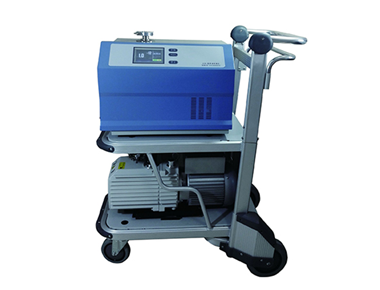
Post-helium testing verifies final seal integrity following electrolyte filling and sealing plug welding. To reduce gas costs, post-helium systems can measure residual helium pre-sealed within the cell interior. Under negative pressure vacuum chamber testing, the finished cell is loaded into a test chamber connected to a vacuum pump system. Upon evacuating the chamber, any internal tracer gas escaping through defective sealing plugs or welds is detected quantitatively, identifying exact leak magnitudes down to sub-micron scales.
1.2 Battery Pack & Enclosure Airtightness Testing
Battery pack leak testing covers PACK trays, top covers, liquid cooling plates, and complete assembled battery enclosures (Atmospheric Accumulation Helium Testing).
Battery cell enclosures, power control units (PCU), electric motor housings, and electronic control modules are engineered to meet the IP67 protection rating (withstanding 1-meter water immersion for 30 minutes with zero moisture ingress).

Testing Methodology Comparison: Pressure Decay vs. Tracer Gas
- Pressure Decay Method: Charges air into the enclosure and measures pressure drop over time. While cost-effective, its sensitivity is limited and unsuitable for fine micro-leaks.
- Tracer Gas Method: Backfills helium gas into the test piece and measures escaping tracer gas using mass spectrometry. Provides ultra-high sensitivity and fast response times.
Industry best practice combines online global testing (Atmospheric Accumulation Method) with offline localized inspection (Sniffer Probe Method).

Atmospheric Accumulation Method (Online Global Testing)
The assembled battery pack is charged with low-concentration tracer gas (e.g., 6% He in N₂) at a low internal differential pressure (~3 kPa) inside an atmospheric accumulation chamber. Blower fans homogenize escaping helium throughout the chamber volume, and a sampling line feeds gas to a helium leak detector to measure total integrated leakage.
- Zero Structural Stress: Low pressure differential (~3 kPa) protects large battery pack enclosures from physical deformation.
- Cost-Efficient Gas Mix: Operates effectively with low helium concentrations (~6% He), cutting gas expenses.
- High Cycle Speed: Delivers fast, automated inline cycle times matching high-volume automotive production lines.

Sniffer Method (Offline Point Location)
When testing assembled battery packs where high vacuum could damage perimeter gaskets or electrical capacitors, offline sniffer testing is deployed. A robotic arm or technician guides a sniffer probe along perimeter weld seams and gasket joints. In static or dynamic tracking modes, the sniffer method rapidly pinpoints precise leak locations.
Section II: Key Technological Advancements in Helium Testing
2.1 Innovations in Detection & Quality Safety
Direct Electrolyte Solvent Vapor Detection
Leading instrumentation developers such as Daxin introduced direct electrolyte solvent detection without helium injection. Under fine vacuum conditions (~few millibars), liquid electrolyte solvents escaping from micro-leaks instantly vaporize and are detected directly by specialized mass spectrometers (e.g., ELT3000). Common detected solvents include Dimethyl Carbonate (DMC), Diethyl Carbonate (DEC), Ethyl Methyl Carbonate (EMC), and Propyl Propionate (PP). For flexible pouch cells, patented flexible membrane chambers support pouch surfaces without structural distortion.
Eliminating Lithium Plating Risks
Conventional secondary helium injection post-electrolyte filling carries a risk of gas entrapment, causing localized uneven current distribution and lithium plating during cell formation. Advanced electrolyte filling & sealing plug leak test equipment verifies seal plug weld integrity without gas injection, removing quality control blind spots and reducing process costs.
2.2 Closed-Loop Helium Recovery & Cost Reduction
Because raw helium is a scarce noble gas (with industrial import dependency exceeding 95% in key manufacturing regions), helium gas accounts for over 50% of leak testing operational expenditure. Major cost-reduction strategies include:
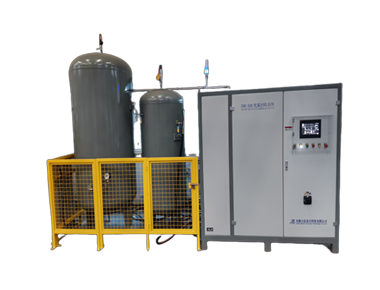
- High-Efficiency Recovery Systems: Closed-loop recovery systems (e.g., Hubei Ruicheng) reclaim up to 85%+ of spent helium.
- Precision Helium Mixing & Standby Control: Smart gas-saving modules (e.g., Shanghai Zundao) automatically switch carrier gas supplies to nitrogen during idle periods.
- Integrated Recovery & Purification Units: On-site purification systems (e.g., Oubi Electronic Tech) re-purify recycled gas for continuous reuse.
- Low-Concentration Testing Protocols: Utilizing 10% low-concentration helium mixture methods (e.g., Guangshun Testing) reduces helium procurement expenses by up to 90%.
2.3 Automated Industry 4.0 Integration
Modern helium leak detection equipment is fully automated for smart battery manufacturing:
- Automated Pressure Monitoring: Touchscreen HMI interfaces provide real-time pressure diagnostics, pass/fail evaluation, and alarm triggers.
- Robotic Material Handling: Synchronized industrial robots execute automated loading, serial number logging, and automatic PASS/FAIL sorting.
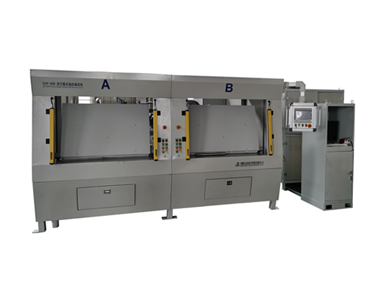
- Multi-Chamber Parallel Architecture: Multi-box linkage enables flexible production lines with rapid tooling changeovers.
- Industrial IoT & Traceability: Integrated IIoT systems store test parameters, enable remote diagnostics, and maintain full digital traceability for quality assurance.
- High-Speed Cylindrical Lines: Advanced line architectures (such as 4680 cylindrical battery leak detection lines by Wanyi Tech) integrate primary testing, secondary testing, recovery, and purification into a continuous automated workflow.
Section III: Industry Conclusion & Outlook
Driven by rapid growth in global electric vehicle and energy storage system (ESS) markets, helium leak detection technology continues to advance rapidly. While domestic equipment manufacturers have significantly closed performance gaps in measurement accuracy, stability, and speed, ongoing engineering efforts focus on overcoming core component import dependencies, enhancing mass spectrometer sensor durability, and expanding closed-loop gas recovery infrastructure.
As battery manufacturing scales toward terawatt-hour (TWh) global capacities, automated high-precision leak detection remains a critical pillar in delivering safe, reliable, and durable energy storage solutions.